
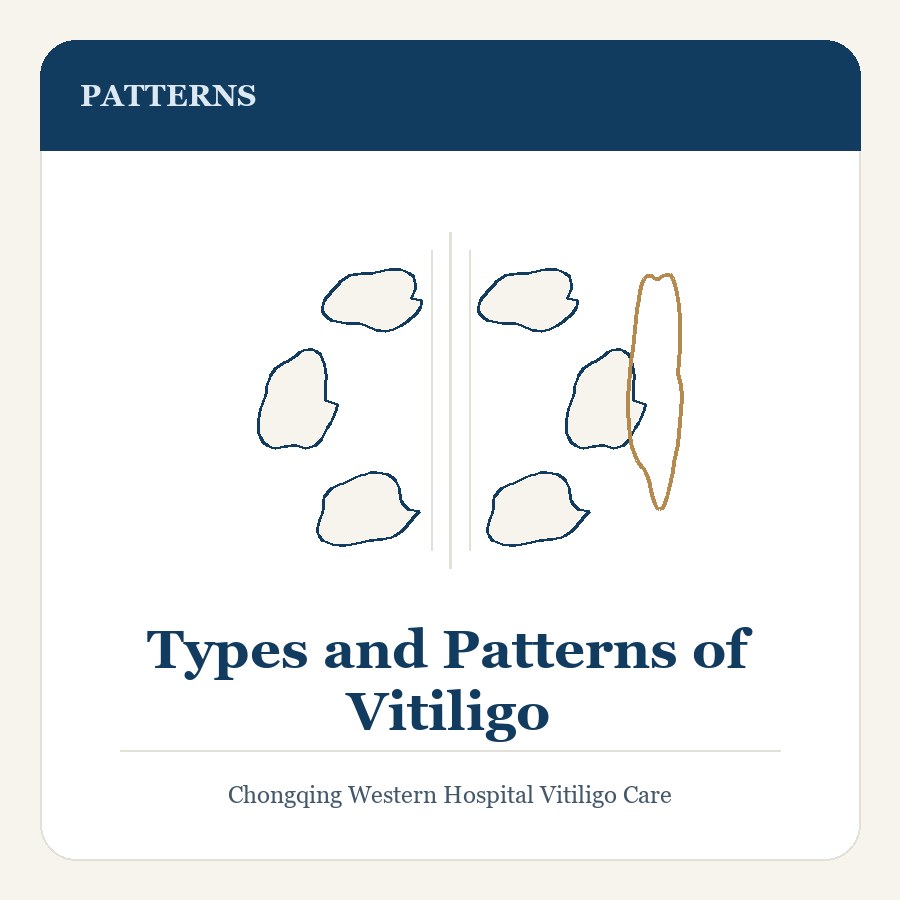
In short. Segmental and non-segmental vitiligo, acrofacial and generalised patterns, and what the distribution suggests about the likely course.
Key points
- The same diagnosis leads to different plans.
- A stable patch on the trunk, a spreading patch on the hand, and widespread involvement across the body are three different problems, and treating them identically wastes both time and hope.
Vitiligo is not one condition but a group of patterns, and the pattern matters. It influences how the disease is likely to behave, how much skin may eventually be involved, and which treatments are worth trying.
Segmental vitiligo
In segmental vitiligo the patches are limited to one side of the body and usually follow a band or a segment, as though a single strip of skin were affected. It often begins in childhood or adolescence and spreads quickly for a period of months, then stops and stays put. Because it stabilises, and because it remains on one side, segmental vitiligo is often the pattern that responds best to surgical treatment. It is also less strongly linked to other autoimmune conditions than the non-segmental forms.
Non-segmental vitiligo
Non-segmental vitiligo is far more common. It affects both sides of the body in a roughly symmetrical way and tends to be progressive, with periods of activity and periods of quiet. Within it, several patterns are recognised.
Acrofacial vitiligo involves the face and the distal extremities — the fingers, the hands, the feet, and the skin around the mouth and eyes. This is a difficult pattern to treat, because the hands, feet and lips are precisely the areas where repigmentation is slowest and least complete.
Generalised vitiligo describes widespread involvement, with many patches scattered across the body. When almost all of the skin has lost pigment, the term universal vitiligo is used. Localised and focal patterns describe limited involvement, which may or may not progress.
What the pattern tells you
Several practical points follow from the pattern. Segmental disease that has been stable for a year is a reasonable candidate for grafting, while active non-segmental disease is not: surgery on active vitiligo tends to fail, and can itself trigger new patches. Widespread disease is usually treated with phototherapy or systemic agents rather than one topical agent at a time. Disease concentrated on the hands, feet and lips deserves an honest conversation about how much repigmentation is realistic, so that months of treatment are not spent chasing an outcome the site cannot deliver.
Pattern guides the plan
The same diagnosis leads to different plans. A stable patch on the trunk, a spreading patch on the hand, and widespread involvement across the body are three different problems, and treating them identically wastes both time and hope.
Ask for reassessment if
- The pattern changes, with stable patches beginning to spread or new areas appearing.
- Pigment loss reaches the eyelids, the lips, the hands, or the genital skin.
- You are offered surgery while the disease is still visibly active.
Frequently asked questions
How does segmental vitiligo behave differently from the non-segmental forms?
Segmental vitiligo is limited to one side of the body and usually follows a band or a segment. It often begins in childhood or adolescence, spreads quickly for a period of months, then stops and stays put. It is also less strongly linked to other autoimmune conditions.
What is acrofacial vitiligo, and why is it difficult to treat?
Acrofacial vitiligo involves the face and the distal extremities, meaning the fingers, the hands, the feet, and the skin around the mouth and eyes. It is a difficult pattern, because the hands, feet and lips are precisely the areas where repigmentation is slowest and least complete.
Which pattern of vitiligo is a reasonable candidate for grafting?
Segmental disease that has been stable for a year is a reasonable candidate for grafting, while active non-segmental disease is not, because surgery on active vitiligo tends to fail and can itself trigger new patches. Widespread disease is usually treated with phototherapy or systemic agents instead.
Risks & Limitations
- Repigmentation is slow, measured in months to years, and is often partial rather than complete.
- Vitiligo is unpredictable: treatment can control it, but nothing guarantees that it will stop spreading.
- Treatment usually needs to continue to hold the result, and relapse is common after it is stopped.
- Prolonged topical steroid use can thin the skin, cause visible blood vessels and stretch marks, and trigger outbreaks of small spots around the hair follicles.
- Phototherapy can burn, and the ultraviolet dose accumulates over a lifetime, raising the risk of skin ageing and skin cancer.
- The face and neck respond best; the hands, feet and lips are the hardest areas, where pigment may never return.
- No treatment works for everyone, and the response of an individual patch cannot be predicted with certainty.
When to Seek Care
- Depigmentation is spreading rapidly, or new patches are appearing over weeks rather than months.
- Depigmentation involves the eyelids or the skin around the eyes.
- New symptoms suggest a thyroid or other autoimmune condition — persistent fatigue, weight change, feeling cold, a neck swelling, or excessive thirst.
- Blistering, burning or severe pain after a phototherapy session — stop treatment and seek advice.
- Eye pain, redness, light sensitivity or blurred vision, which need prompt assessment.
References & Further Reading
- American Academy of Dermatology (AAD) — public and clinical guidance on vitiligo
- Vitiligo Research Foundation — patient and clinician information resources
- Cochrane Library — systematic reviews of vitiligo treatment
- Chinese Medical Association, Dermatology Branch — clinical guidance
This page is patient education, not medical advice, and it does not cite individual studies. Discuss your own case with a qualified clinician. To arrange an assessment at Chongqing West District Hospital, see Contact & Consultation.