
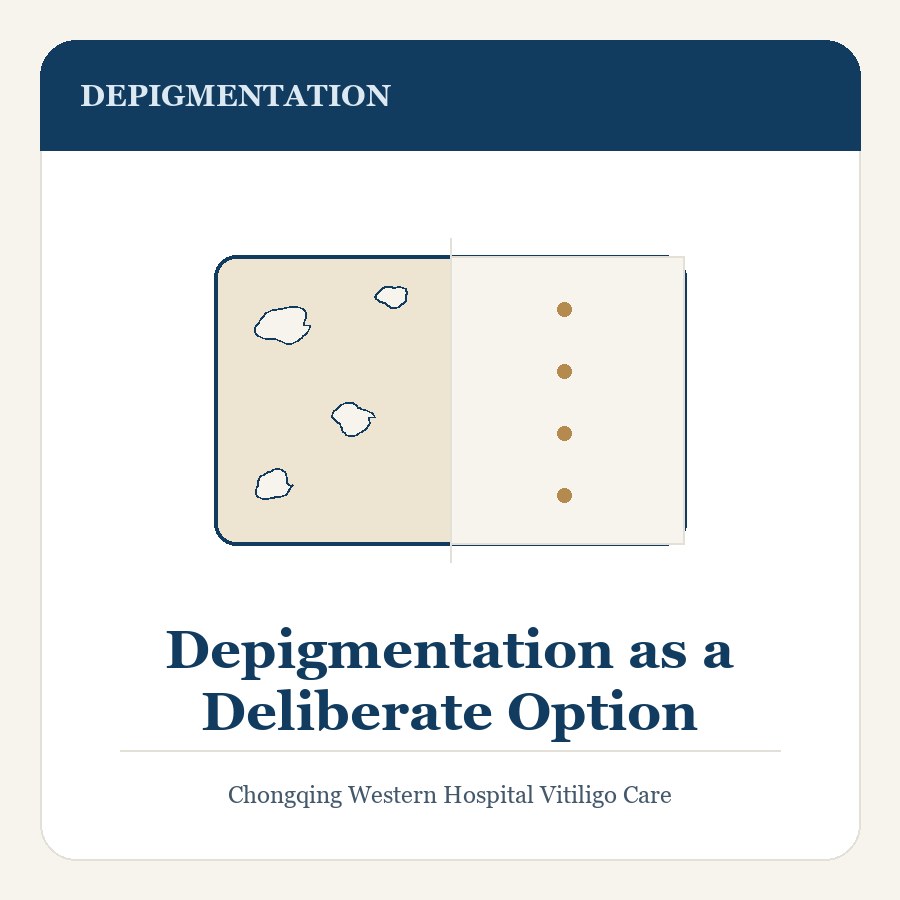
In short. When vitiligo already covers most of the body, removing the remaining pigment can be a rational choice. What it involves, and why it is irreversible.
Key points
- Choosing depigmentation is not giving up.
- For someone whose vitiligo already covers most of the body, it can be the option that produces the most tolerable result.
- It deserves a frank conversation about permanence, sun protection and follow-up, not a whisper.
For most people with vitiligo the goal is to restore pigment. But when vitiligo has already taken most of the body, restoring pigment in the few remaining areas may be neither realistic nor desirable, and a different option becomes reasonable: removing the pigment that is left, so that the skin becomes uniformly pale instead of patchy.
Why anyone would choose it
The argument is appearance, and it is a legitimate one. Patchy skin draws attention; uniformly depigmented skin is simply very pale, and many people find that far easier to live with. Depigmentation removes the daily contrast between affected and unaffected skin, and with it the need to explain. For people with widespread vitiligo, commonly taken as involvement of roughly half the body surface or more, particularly on the face and hands, it can be a rational choice rather than a last resort.
How it is done
Depigmentation is achieved with a topical agent that destroys the remaining melanocytes. It is applied to the normally pigmented skin, usually over a large area, and the process takes time: months to a couple of years for a full effect, with the face responding fastest and the hands and feet slowest. It is done under dermatological supervision, with the skin reviewed at intervals. Lightening is gradual and usually begins within weeks of starting, but completion is slow.
The commitment it involves
Depigmentation is irreversible. The melanocytes that are removed do not come back, and the skin will not repigment later. That is the single most important thing to understand before starting, and it is why the decision is made deliberately, with time to think, rather than in a single consultation.
It also creates a lifelong responsibility. Skin with no melanin has no natural protection from ultraviolet light. It burns readily, ages faster, and carries a higher risk of skin cancer, so daily sun protection, protective clothing and regular skin examination become permanent parts of the routine. The eyes are a separate matter: the pigment in the retina is unaffected by skin depigmentation, but the skin around the eyes needs particular care, and any treatment near the eyes is approached cautiously.
A decision, not a defeat
Choosing depigmentation is not giving up. For someone whose vitiligo already covers most of the body, it can be the option that produces the most tolerable result. It deserves a frank conversation about permanence, sun protection and follow-up, not a whisper.
Before starting, make sure
- You understand that the change is permanent and cannot be reversed.
- You accept lifelong daily sun protection and regular skin checks.
- You have had time and a second conversation, not only one appointment.
Frequently asked questions
Who is depigmentation intended for?
It is for people whose vitiligo already covers most of the body, commonly taken as involvement of roughly half the body surface or more, particularly on the face and hands. In that situation, restoring pigment in the few remaining areas may be neither realistic nor desirable.
Can depigmentation be reversed if I change my mind?
No. Depigmentation is irreversible. The melanocytes that are destroyed do not come back, and the skin will not repigment later. That is the single most important thing to understand before starting, which is why the decision is made deliberately, with time to think rather than in a single consultation.
What lifelong responsibility does depigmentation create?
Skin with no melanin has no natural protection from ultraviolet light. It burns readily, ages faster, and carries a higher risk of skin cancer, so daily sun protection, protective clothing and regular skin examination become permanent parts of the routine. The skin around the eyes needs particular care.
Risks & Limitations
- Repigmentation is slow, measured in months to years, and is often partial rather than complete.
- Vitiligo is unpredictable: treatment can control it, but nothing guarantees that it will stop spreading.
- Treatment usually needs to continue to hold the result, and relapse is common after it is stopped.
- Prolonged topical steroid use can thin the skin, cause visible blood vessels and stretch marks, and trigger outbreaks of small spots around the hair follicles.
- Phototherapy can burn, and the ultraviolet dose accumulates over a lifetime, raising the risk of skin ageing and skin cancer.
- The face and neck respond best; the hands, feet and lips are the hardest areas, where pigment may never return.
- No treatment works for everyone, and the response of an individual patch cannot be predicted with certainty.
When to Seek Care
- Depigmentation is spreading rapidly, or new patches are appearing over weeks rather than months.
- Depigmentation involves the eyelids or the skin around the eyes.
- New symptoms suggest a thyroid or other autoimmune condition — persistent fatigue, weight change, feeling cold, a neck swelling, or excessive thirst.
- Blistering, burning or severe pain after a phototherapy session — stop treatment and seek advice.
- Eye pain, redness, light sensitivity or blurred vision, which need prompt assessment.
References & Further Reading
- American Academy of Dermatology (AAD) — public and clinical guidance on vitiligo
- Vitiligo Research Foundation — patient and clinician information resources
- Cochrane Library — systematic reviews of vitiligo treatment
- Chinese Medical Association, Dermatology Branch — clinical guidance
This page is patient education, not medical advice, and it does not cite individual studies. Discuss your own case with a qualified clinician. To arrange an assessment at Chongqing West District Hospital, see Contact & Consultation.