
In short. Stable and active vitiligo, the Koebner phenomenon, and why judging activity decides the whole treatment plan.
Key points
- People often believe their vitiligo is stable because it looks unchanged to them.
- Careful examination, a Wood's lamp, and comparison with earlier photographs regularly show otherwise.
- The assessment is worth doing properly, because the plan depends on it.
Before any treatment is chosen, a dermatologist asks one question: is this vitiligo active or stable? The answer changes everything, because the treatments that stop the disease spreading are not the same as the treatments that restore pigment, and giving the wrong one wastes months.
What active disease looks like
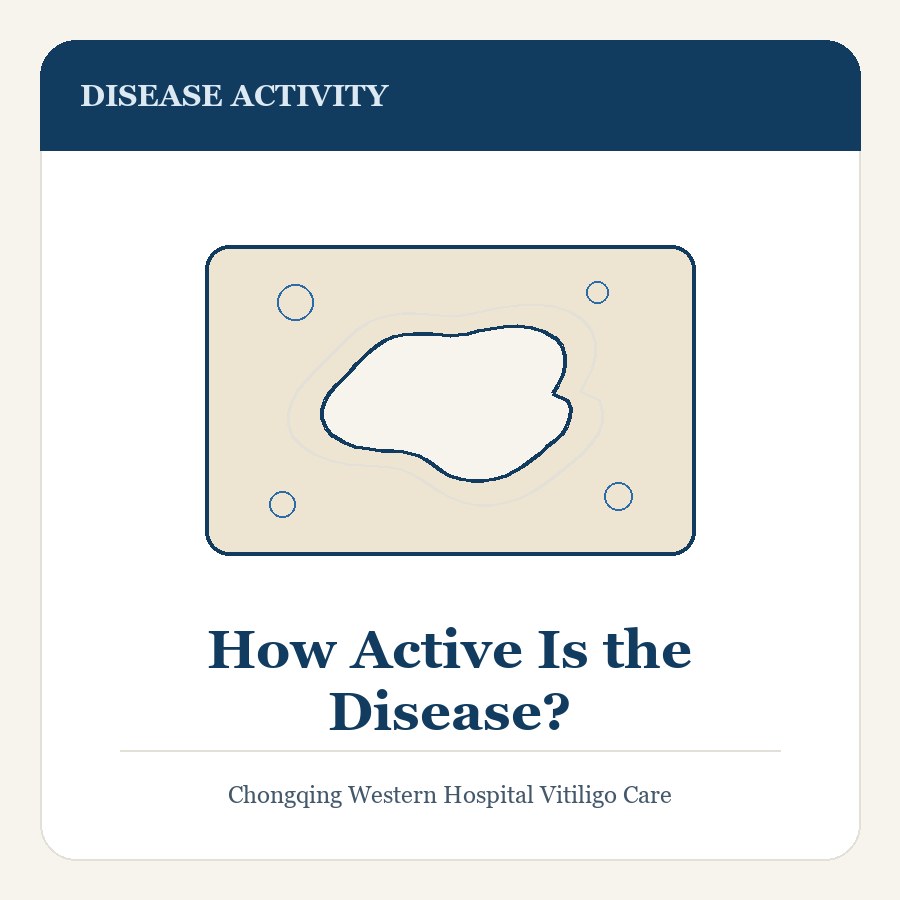
Active vitiligo is disease on the move. New patches appear, existing patches enlarge, and the borders change. The signs are often subtle. A trichrome patch, one with a white centre, a paler middle zone and normal skin at the edge, suggests the process is still running. An inflamed or slightly raised border, or a border that is poorly defined, is another clue. Confetti-like spots, small pale macules scattered around an established patch, point the same way, as does pigment loss that has appeared in a new area within the last few months.
Activity is judged over time. Photographs taken in consistent lighting are genuinely useful, and a clinician may compare the extent of involvement at two visits several months apart. Blood tests for thyroid function and other autoimmune markers are commonly arranged, since active disease and thyroid autoimmunity often travel together.
The Koebner phenomenon
Vitiligo can appear at sites of injury. This is the Koebner phenomenon, and it means that cuts, burns, scratches, friction from tight clothing, sunburn, and even some cosmetic procedures can trigger a new patch of pigment loss in someone whose disease is active. It is the reason surgery is avoided during active disease, and the reason people are advised to treat eczema and other itchy conditions promptly rather than scratching.
Stable disease
Stable vitiligo is disease that is not currently moving. In practice, stability is usually judged over a defined period, commonly a year without new patches and without enlargement of existing ones. Stability is not necessarily permanent, which is why even successful treatment needs follow-up.
Why this decides the plan
In active disease the priority is to stop the spread, using treatments that calm the immune attack; restoring pigment becomes a secondary goal until the disease settles. In stable disease the focus shifts, and phototherapy, topical treatment directed at repigmentation, and in suitable cases surgical grafting all become reasonable. Operating on active disease risks failure and can provoke further depigmentation.
Activity is assessed, not assumed
People often believe their vitiligo is stable because it looks unchanged to them. Careful examination, a Wood's lamp, and comparison with earlier photographs regularly show otherwise. The assessment is worth doing properly, because the plan depends on it.
Report promptly if
- New patches have appeared in recent months, or existing ones have grown.
- Pigment loss has started at a site of injury, surgery, or repeated friction.
- The border of a patch has become red, raised, or itchy.
Frequently asked questions
What does a trichrome patch tell the dermatologist?
A trichrome patch has a white centre, a paler middle zone and normal skin at the edge. That appearance suggests the process is still running, meaning the disease is active rather than stable. Activity, in turn, decides which treatments are appropriate.
What is the Koebner phenomenon, and what does it mean in practice?
Vitiligo can appear at sites of injury. Cuts, burns, scratches, friction from tight clothing, sunburn, and even some cosmetic procedures can trigger a new patch of pigment loss when the disease is active. It is why surgery is avoided during active disease and why itchy skin conditions are treated promptly.
How is stable disease actually defined?
In practice, stability is usually judged over a defined period, commonly a year without new patches and without enlargement of existing ones. Stability is not necessarily permanent, which is why even successful treatment needs follow-up.
Risks & Limitations
- Repigmentation is slow, measured in months to years, and is often partial rather than complete.
- Vitiligo is unpredictable: treatment can control it, but nothing guarantees that it will stop spreading.
- Treatment usually needs to continue to hold the result, and relapse is common after it is stopped.
- Prolonged topical steroid use can thin the skin, cause visible blood vessels and stretch marks, and trigger outbreaks of small spots around the hair follicles.
- Phototherapy can burn, and the ultraviolet dose accumulates over a lifetime, raising the risk of skin ageing and skin cancer.
- The face and neck respond best; the hands, feet and lips are the hardest areas, where pigment may never return.
- No treatment works for everyone, and the response of an individual patch cannot be predicted with certainty.
When to Seek Care
- Depigmentation is spreading rapidly, or new patches are appearing over weeks rather than months.
- Depigmentation involves the eyelids or the skin around the eyes.
- New symptoms suggest a thyroid or other autoimmune condition — persistent fatigue, weight change, feeling cold, a neck swelling, or excessive thirst.
- Blistering, burning or severe pain after a phototherapy session — stop treatment and seek advice.
- Eye pain, redness, light sensitivity or blurred vision, which need prompt assessment.
References & Further Reading
- American Academy of Dermatology (AAD) — public and clinical guidance on vitiligo
- Vitiligo Research Foundation — patient and clinician information resources
- Cochrane Library — systematic reviews of vitiligo treatment
- Chinese Medical Association, Dermatology Branch — clinical guidance
This page is patient education, not medical advice, and it does not cite individual studies. Discuss your own case with a qualified clinician. To arrange an assessment at Chongqing West District Hospital, see Contact & Consultation.